
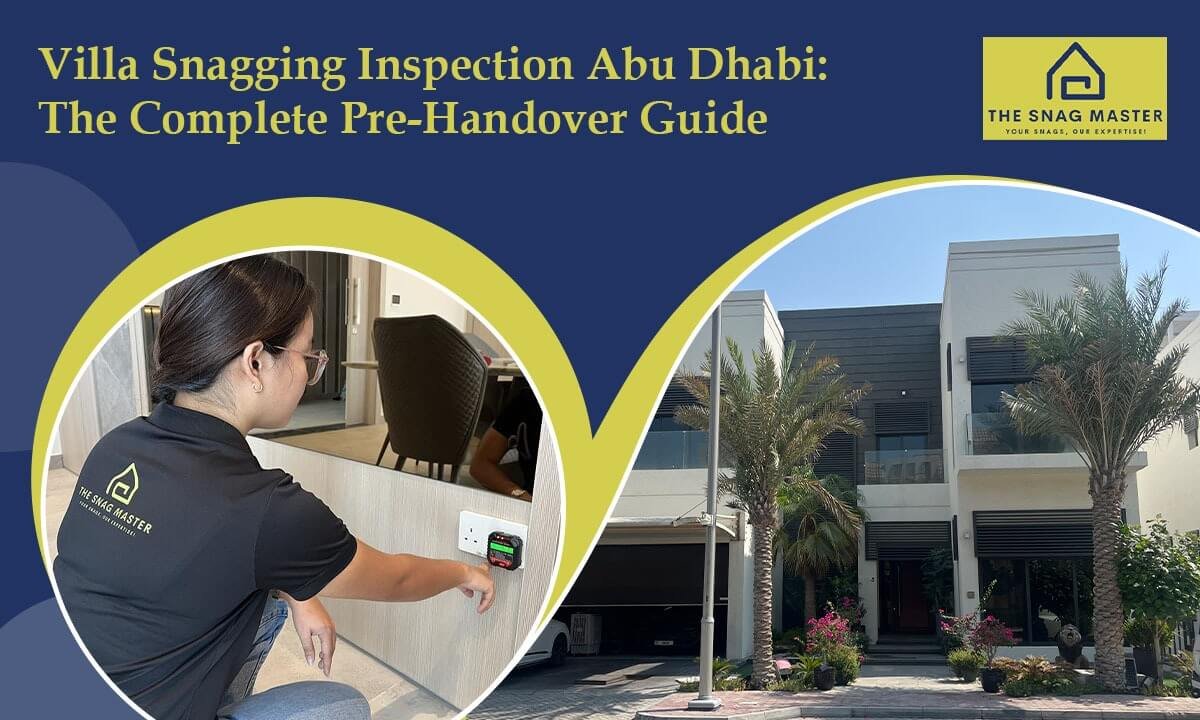
The Snag Master carried out a complete pre-handover villa snagging inspection at Toledo, part of Bloom Holding’s Bloom Living community in Zayed City, Abu Dhabi. The survey ran ground floor to roof and garage to garden: architectural finishes, doors and joinery, the kitchen and every appliance, bathrooms and wet areas, and the mechanical, electrical and plumbing systems most buyers never see – distribution boards, fan coil unit filters, HVAC access panels, roof water tanks and solar water heaters. Every item found was photographed, located by room and assigned to a trade, then issued to the owner before the handover documents were signed.
A handover happens once. What is recorded before the signature is the developer’s responsibility. What is missed becomes a maintenance bill.
Why was a snagging inspection needed on a well-built villa?
Because inspection is not a verdict on a developer. The finish quality at Toledo was good – and a well-built villa still produces a working list.
A villa is assembled by a dozen trades in sequence, and the last trade in always disturbs the work of the one before. Tilers follow blockwork, joiners follow tilers, painters follow joiners, and the MEP contractor returns after all of them to commission systems behind panels that were already closed. The defects that survive to handover are rarely failures of skill. They are handover-stage residue: alignment that drifted, sealant that was run before a surface was clean, a filter that was never changed after construction dust.
A villa also carries far more inspectable surface than an apartment. The owner inherits the entire building envelope, the plant on the roof, the garden and irrigation, the boundary walls and the drainage – none of which sits behind a building manager. Nobody is coming to check the roof but the owner.
How was the villa inspected, ground floor to roof?
The villa was worked in a fixed sequence so that no area could be skipped and every finding could be located by room in the report.
- Garage and entrance. Carport levels and paving falls, garage door operation, external wall and soffit finishes, entrance door alignment and threshold detail.
- Ground floor. Living and family rooms, dining, guest bedroom and bathroom, store and laundry, maid’s quarters – walls, ceilings, floor and wall tiling, skirting, doors and switching.
- Kitchen. Every appliance run under power. Cabinet carcasses and shutters opened and closed. Stone counters checked at the joint and at the sink cut-out.
- Staircase and first floor. Handrails and balustrade fixings, nosings, bedrooms and en-suites, dressing rooms, wardrobes and balconies.
- Wet areas. Drainage falls water-tested, traps and waste terminations checked, sanitaryware fixings, shower screens and sealant lines.
- MEP. Distribution boards opened and reviewed, FCU filters pulled, HVAC access panels checked for provision and fit, sockets and fittings tested for alignment and termination.
- Roof. Water tanks accessed and checked for cleanliness and sealing, solar water heating panels and cylinders reviewed, condenser units and access hatches inspected.
- Garden and external works. Irrigation, external lighting alignment, boundary walls and gates, drainage covers, manholes and paving levels.
Why engineers, not technicians?
A technician with a checklist can record a scratched door. It takes an engineer to look at a stain on a ceiling and work backwards to the wet area above it – and to know which of the two is actually the defect.
What did the inspection find?
The findings followed the pattern we see repeatedly across new Abu Dhabi villas. Listed in order of frequency:
- Doors, windows and joinery. The largest single category, as it is in almost every villa we inspect – closing action and alignment, hinge and strike-plate finish, brush seals, sliding-track rollers, colour variation across frame and architrave, and the termination between frame and wall.
- Tiling, marble and grouting. Hollow or chipped tile beds, inconsistent grout lines, uneven levels at thresholds, trim terminations left unfinished.
- Paint and wall finishes. Undulation under raking light, repair marks visible through the final coat, cracking at junctions between materials.
- Wet-area terminations. Drain connections, waste pipe finishing and sealant lines – the joints that separate a dry wall from a wet one for the next decade.
- MEP items left over from construction. Fan coil unit filters still carrying construction dust, access panels not sitting flush, unaligned switch plates, and roof water tanks needing cleaning before occupation.
None of it was structural. That is precisely why this category of defect is missed on a buyer’s own walkthrough – and why it ends up being paid for by the owner rather than the developer.
What buyers consistently underestimate
Most of what is found is not dramatic. It is a door that will bind in eighteen months, a drain termination that will weep, a filter that was never cleaned after construction.
None of it is visible on a viewing. All of it is chargeable to somebody – and the handover date decides who
What did the roof and MEP inspection reveal that the buyer could not?
This is the part of a villa handover that a buyer cannot reasonably self-assess, and it is where the expensive defects hide.
- Roof water tanks. Tank interiors and lid sealing checked before first fill. A tank commissioned with construction debris inside becomes a water-quality problem the owner pays to solve.
- Solar water heaters. Panels, cylinders, mountings and pipe insulation reviewed. Poorly commissioned solar heating quietly shifts load onto the electric element and inflates monthly ADDC bills.
- Fan coil unit filters and AC grilles. Filters pulled and inspected. A dirty filter at handover reduces cooling output from day one and raises consumption for as long as it stays in place.
- Distribution boards and ELV enclosures. Labelling, termination quality, cover fit and access provision – the difference between a five-minute future repair and a wall being opened.
- HVAC access panels. Checked for provision and fit. A ceiling with no access panel where one is needed is a defect that only becomes obvious when maintenance is already required.
What did the owner receive?
A detailed report, issued room by room, with each observation photographed, located, and described in plain language alongside the trade responsible. It is written to be forwarded – a document the developer’s handover team can act on directly, without translation or argument.
Where required, a de-snagging visit follows. Every item on the original list is re-opened and re-checked to confirm it was properly rectified rather than simply marked as closed. A snag list is an opinion until somebody goes back and verifies it.
Why did the timing of the inspection matter more than its length?
Two clocks start the moment a property is completed, and they run at very different speeds.
Ten years – structural. Under UAE decennial liability, developers and contractors remain answerable for defects affecting the structural safety and stability of a building for ten years. In Abu Dhabi, the framework sits under Law No. 3 of 2015 regulating the real estate sector, administered by the Abu Dhabi Real Estate Centre, and runs from the final completion certificate.
One year – installations. Everything that is not structural – MEP systems, installations, workmanship and finishing – typically carries a one-year defects liability period from handover, set out in the sale and purchase agreement. This is the window almost every villa defect actually falls into.
Every finding at Toledo sat inside the shorter clock. Recorded before signature, they remained the developer’s obligation to complete. Recorded in month fourteen, the same list would have been a conversation about goodwill.
This is general information, not legal advice; the specific terms of your sale and purchase agreement govern your position.
When should a villa in Abu Dhabi be inspected?
- Before handover. The ideal window, and the one used here. Defects are recorded while the developer’s obligation is at its strongest and before the owner has signed to accept the property’s condition.
- Before the DLP expires. A re-inspection ahead of the one-year mark catches everything that surfaced through the first summer of cooling load and the first cycle of living in the house.
- Before a resale purchase. On the secondary market there is no developer obligation at all, which makes an independent pre-purchase inspection the only protection a buyer has.
- At any age. A Building Condition Audit gives owners an engineering picture of a property already in use.
Taking handover this year?
Have the villa inspected while the small things are still small. That is the one window in which fixing them costs you nothing.
FAQS: Your Pre-Handover Questions Answered
What is a villa snagging inspection?
A villa snagging inspection is an independent, engineer-led survey of a new villa carried out before handover. Every item that is incomplete, damaged or below specification is photographed, located by room and assigned to the responsible trade, then issued as a report the developer is expected to rectify before the owner signs.
What did The Snag Master inspect at Toledo, Bloom Living?
The full villa, ground floor to roof. Garage, entrance, living and family areas, kitchen, every bedroom and bathroom, store and laundry rooms, staircase, balconies, garden and roof – covering finishes, doors and joinery, kitchen appliances, wet areas, and MEP systems including distribution boards, FCU filters, water tanks and solar heaters.
How long does a villa snagging inspection take?
A villa of this size takes most of a working day. Appliances are run under power, drainage is water-tested, every door and window is operated, and roof plant is accessed. Compressing the visit into an hour produces a cosmetic list and misses the systems that cost money later.
Were the defects found at Bloom Living serious?
No – and that is the point. The build quality was good. What the inspection recorded were alignment, sealant, termination and commissioning items: a door that will bind within two years, a drain that will weep, an FCU filter still carrying construction dust. Small now, chargeable later.
Who pays to fix defects found before handover?
The developer. Items recorded and issued before the handover documents are signed sit inside the developer’s obligation to complete the property to specification. The same items discovered after signature usually become the owner’s maintenance cost, which is why the timing of the inspection matters more than its length.
What is the defects liability period in Abu Dhabi?
Developers remain liable for structural defects for ten years from the final completion certificate under UAE decennial liability, applied in Abu Dhabi through Law No. 3 of 2015 and administered by the Abu Dhabi Real Estate Centre. Installation, MEP and workmanship defects usually carry one year from handover under the SPA.
Does The Snag Master re-check the developer’s repairs?
Yes. A de-snagging visit re-opens every item on the original list to confirm it was genuinely rectified rather than marked closed. A snag list is an opinion until somebody returns and verifies it, so the report is only considered complete once the second visit is recorded.
Who carries out the inspections?
InterNACHI-certified civil engineers following RICS methodology – not technicians working from a checklist. The Snag Master is RERA-certified and DED-licensed and inspects villas, apartments, commercial units, and full buildings across Abu Dhabi, Dubai, and the wider UAE.
Great design is just the start. Quality assurance is the finish line.
Whether it’s a townhouse in Zayed City or a villa on the coast, make sure your property is thoroughly inspected before the keys change hands. Book your professional inspection with The Snag Master today and get peace of mind knowing your new property has been checked by experienced engineers across Abu Dhabi, Dubai and the UAE.