
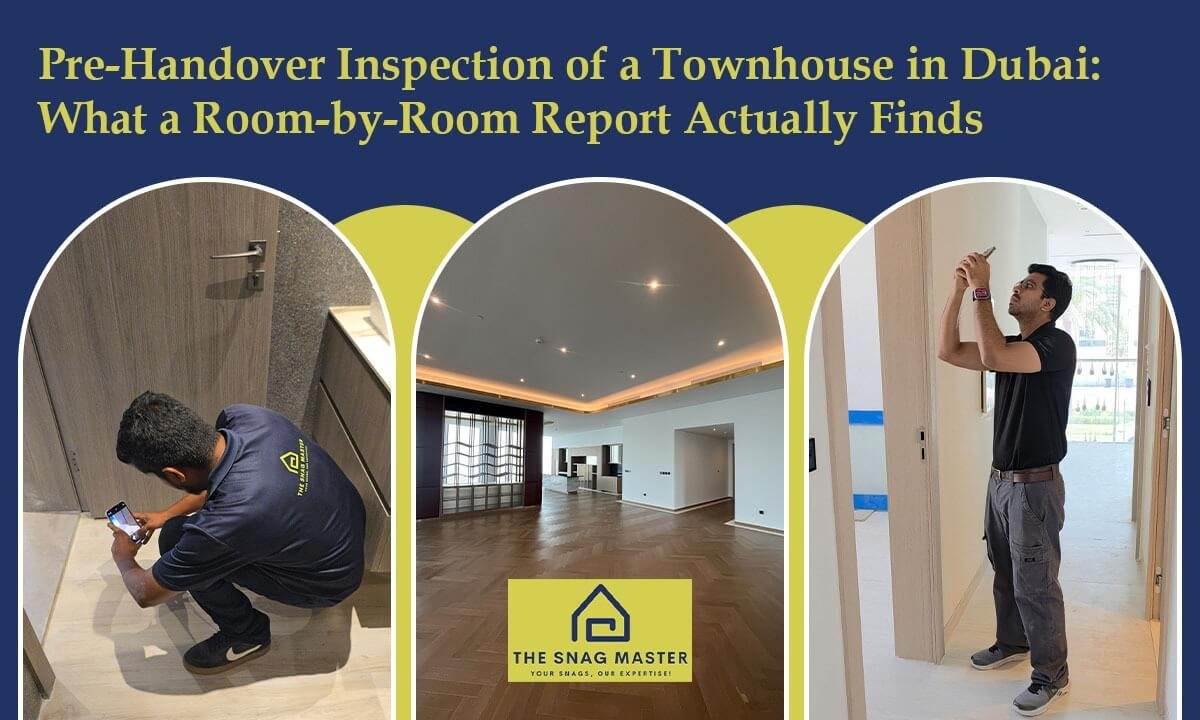
A pre-handover inspection of a townhouse in Dubai is a room-by-room assessment of the property’s finishes, joinery, wet areas, and building services (MEP) carried out before the buyer accepts the keys from the developer. Even when a townhouse presents well on a walkthrough, a structured inspection typically uncovers a mix of finish-level issues – such as tiling and grout defects – and service-related issues, including electrical protection, drainage, and HVAC faults, that are far more disruptive to resolve once the property is occupied. The inspection produces a documented snag report the buyer can submit to the developer for correction during the Defects Liability Period (DLP), and it becomes the shared reference point for any item raised afterward.
Case Study: A Townhouse Pre-Handover Inspection in Jebel Ali Village
The Snag Master recently carried out a pre-handover inspection of a townhouse in Jebel Ali Village, Dubai. On first impression, the property presented well – clean finishes, straight lines, nothing obviously out of place. This is exactly where a structured, room-by-room inspection earns its value: presentation and condition are not the same thing, and the gap between the two is usually found in the details a walkthrough moves past too quickly.
Our civil engineers assessed the townhouse across four main categories: tiling, doors and joinery, wet areas, and MEP (mechanical, electrical and plumbing) systems. Each is covered below with what we check and why it matters for a townhouse specifically, where multiple floors, external elevations and private wet areas add complexity that a single-level apartment inspection doesn’t have.
What a Townhouse Pre-Handover Report Covers
1. Tiling
Tiling defects are some of the most common findings in any Dubai handover, and townhouses – with more floor area and often large-format tiles across open-plan living spaces – are no exception. Our inspectors check:
- Grout consistency across runs, joints and transitions between rooms
- Hollow beds using a tap test to identify tiles that are not properly bonded to the substrate, a common cause of future cracking
- Level across large-format floors, since format tiles show even small height differences more visibly than smaller ones
- Edge trims, skirting alignment and transitions between tile and other flooring types
Most tiling issues are cosmetic and straightforward for the developer to correct. The concern is less the individual defect and more what a high count of them signals about overall finishing quality.
2. Doors and Joinery
Townhouses typically have more doors than an equivalent apartment – internal doors across multiple floors, wardrobes, kitchen cabinetry and external doors exposed to Dubai’s heat and humidity cycles. We check:
- Alignment – whether doors hang square in their frames
- Closing gaps – consistent clearance around the full frame, not just at the handle side
- Soft-close mechanisms on cabinetry and select doors, confirming they engage correctly and aren’t already showing wear
- Locking mechanisms, hinges and handle fixings
Misaligned joinery is easy to miss on a casual walkthrough because a door can look fine closed but bind or drop over time. Catching it before handover means the developer resolves it under warranty rather than the owner living with it.
3. Wet Areas
Townhouses generally have more wet areas than apartments – multiple bathrooms, a powder room, sometimes a maid’s room, and occasionally external areas depending on layout. Wet areas are where finish-level problems and service-related problems most often overlap. We assess:
- Floor slope, to confirm water drains toward the outlet rather than pooling
- Drainage performance and outlet positioning
- Sealant terminations around baths, showers, basins and floor-wall junctions, where poor sealant is a leading cause of hidden water ingress into adjacent rooms or the floor below
A wet area that looks finished can still fail on slope or sealant – defects that aren’t visible until water is actually run through the space, which is why a structured test matters more here than almost anywhere else in the property.
4. MEP (Mechanical, Electrical & Plumbing)
This is the category most likely to affect how a townhouse actually performs once occupied, and the one buyers are least equipped to assess themselves. Our engineers check:
- Electrical protection – correct circuit protection, earthing and labelling at the distribution board
- FCU (fan coil unit) filters and ductwork – a frequent source of poor airflow and higher running costs if not installed or maintained correctly from handover
- Light fittings – correct operation, fixing and circuit allocation across every room and floor
Finish-level items like tiling and paintwork are usually simple and inexpensive to resolve. MEP and other service-related items are the ones worth catching before a property is occupied – they’re harder to diagnose after move-in, more disruptive to fix around furniture and daily life, and in the case of electrical protection, they carry a genuine safety dimension.
Why This Matters More for a Townhouse Than a Single-Level Apartment
A townhouse inspection covers more ground than a typical apartment inspection: multiple internal levels, an external elevation and roof exposed to the elements, private wet areas rather than shared ones, and often a private garden or terrace with its own drainage considerations. Each additional zone is another place a developer’s finishing team can vary in quality from room to room – which is exactly why a room-by-room, engineer-led approach outperforms a general walkthrough on a property of this size.
What Happens After the Inspection
Once the inspection is complete, findings are compiled into a photographic snag report and shared with the buyer. This report:
- Documents every issue with photos and location references
- Gives the buyer a clear, developer-ready list to submit for correction
- Creates a dated record of the property’s condition at handover
- Becomes the shared reference point for anything raised later during the Defects Liability Period (DLP)
If items are disputed or re-inspected after the developer’s repairs, having an independent, documented baseline from the original inspection makes that follow-up conversation far more straightforward – for the buyer and the developer.
Something to Consider Ahead of Your Handover Date
A property that “presents well” on a walkthrough and a property that is actually ready for occupation are two different things. The finish-level items your eye catches are rarely the ones that cause problems later – it’s the items behind the finish, like drainage, sealant, and electrical protection, that are worth having checked by someone trained to look for them. If your townhouse handover date is approaching, booking a pre-handover inspection ahead of time gives you a documented record of condition and time to have issues addressed before you take the keys.
Frequently Asked Questions
What does a pre-handover inspection of a townhouse in Dubai include?
It includes a room-by-room assessment covering tiling, doors and joinery, wet areas (floor slope, drainage and sealant), and MEP systems (electrical protection, FCU filters, ductwork and light fittings), delivered as a photographic snag report.
How is a townhouse inspection different from an apartment inspection?
A townhouse typically spans multiple levels and includes an external elevation, private wet areas and sometimes a garden or terrace – all additional zones that a single-level apartment inspection doesn’t need to cover, which generally means more checkpoints and a longer on-site inspection.
Are tiling issues found during a pre-handover inspection serious?
Most tiling defects – grout inconsistency, hollow beds, or uneven levels – are cosmetic and straightforward for the developer to fix under warranty. They’re still worth documenting, since a high count of finish-level issues is often a signal to look more closely at the property’s service-related systems too.
Why do MEP issues matter more than finish-level issues?
Finish-level items like tiling or paintwork are usually quick and inexpensive to resolve. MEP issues – such as incorrect electrical protection or a poorly maintained FCU—are harder to diagnose after move-in, more disruptive to fix once the property is furnished and occupied, and in some cases carry a safety dimension.
When should I book a pre-handover inspection for my townhouse?
Ideally, book the inspection as soon as your handover date is confirmed, so there’s time for the developer to address any findings before you take possession. Inspecting after signing off on handover removes much of your leverage to have issues corrected at the developer’s cost.
Does The Snag Master inspect townhouses outside Dubai as well?
Yes. The Snag Master carries out townhouse and villa pre-handover inspections across all seven UAE emirates – Dubai, Abu Dhabi, Sharjah, Ajman, Ras Al Khaimah, Umm Al Quwain and Fujairah.
Your townhouse presents well. A room-by-room inspection tells you what’s actually behind the finish.
Book a pre-handover inspection with The Snag Master’s qualified civil engineers – RERA-certified, covering all seven UAE emirates, with a photographic report delivered within 24 hours.