
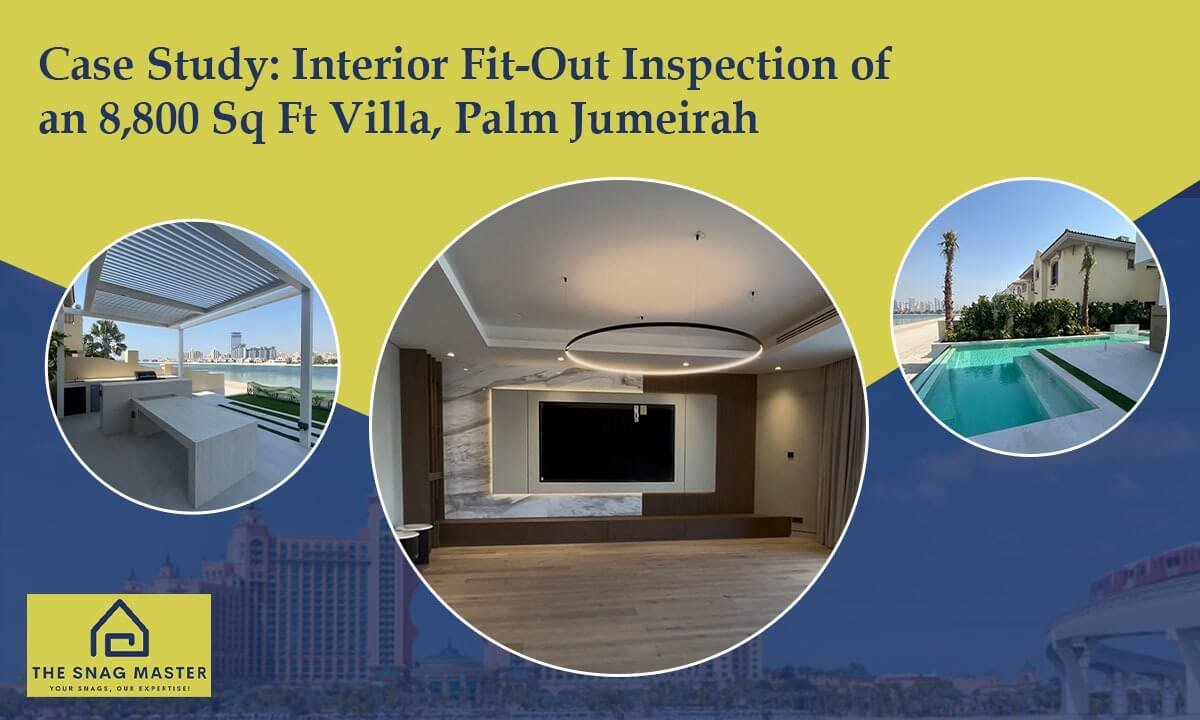
The Snag Master carried out an engineer-led interior fit-out inspection on an 8,800 square foot villa on Palm Jumeirah before the owner accepted handover. The villa was finished to a high standard throughout, with polished stone, seamless joinery, and a fully completed interior. The inspection covered every room and every building system, including MEP and electrical, chilled-water and FCU cooling performance, plumbing and drainage, waterproofing and moisture, tiling and stone, joinery and ironmongery, and paint and surface finishes, using thermal imaging and moisture mapping to check what a visual walkthrough cannot. The case demonstrates why a flawless finish on a large, high-value home still requires an independent, system-by-system inspection before sign-off.
The Property
An 8,800 square foot villa on Palm Jumeirah, recently completed with a high-end interior fit-out: polished stone flooring, seamless joinery, and finishes built to impress from the moment you walk through the door. On day one, it looked exactly as a home at this level should look.
That is precisely the moment that matters most. A finish that looks right and a finish that is right rarely announce the difference on move-in day. It tends to show up a year later, quietly and expensively, once the property is in daily use.
Why the Owner Booked an Inspection
The owner was preparing to accept handover and wanted independent confirmation of what sat behind the finish, not just how the villa presented on a walkthrough. Premium materials and expert styling are designed to impress the eye. They are not designed to reveal hollow tile beds under a perfectly laid floor, a moisture path behind a pristine wall, or a cooling system that looks installed but is underperforming.
On a home of this scale, the risk compounds. The larger the property, the more surface area there is for a small defect to sit unnoticed, and the more it can cost to put right once the keys have changed hands and the contractor’s obligation has ended.
What Our Engineers Inspected
The inspection was carried out floor by floor and system by system across the full 8,800 square feet, not as a visual walkthrough but as an engineering-grade quality check:
- MEP and electrical – distribution, connections and safety
- Chilled-water and FCU performance – confirming the cooling system works as designed, not just as installed
- Plumbing and drainage – supply lines, fall, and leak checks
- Waterproofing and moisture – wet areas, roofs and the building envelope, using moisture mapping to trace paths invisible to the eye
- Tiling and stone – levels, alignment and hollow-bed detection across the polished stone flooring
- Joinery, doors and ironmongery – fit, function and finish of the villa’s seamless joinery
- Paint and surface finishes – consistency and preparation
- Thermal imaging – used throughout to reveal what a visual inspection cannot
The inspection was carried out by civil engineers assessing every building system, not technicians working through a surface checklist, in line with RERA certification, DED licensing, InterNACHI accreditation, and RICS methodology.
Why This Matters on a High-Value Home
A flawless surface finish says almost nothing about the workmanship behind it. Waterproofing, MEP connections and sealed-in finishes are invisible once a home is occupied — which is exactly why they need checking before that happens, while the contractor is still responsible for making it right.
An inspection at this stage is a small, one-time cost at the point where the owner’s leverage is highest: before sign-off, while defects are still the contractor’s problem to fix rather than the owner’s bill to pay. Skip it, and a minor issue documented today can become a major repair tomorrow — from repeat cooling faults to water damage that only surfaces well after handover.
On a villa at this level, that is not a minor detail in the process. It is the entire point of commissioning an independent inspection.
The Outcome
The inspection gave the owner a documented, evidence-based report on the true condition of the villa’s finishes and systems before accepting handover, with time still available to have any issues addressed at the contractor’s cost. Instead of relying on how the home looked on move-in day, the owner had a floor-by-floor, system-by-system record of what was actually built, backed by thermal imaging and moisture mapping rather than a visual impression.
Have your home inspected before you sign.
Whether it’s a villa in Palm Jumeirah or an apartment anywhere else in the UAE, an interior fit-out inspection gives you proof instead of an assumption before you accept handover.
Frequently Asked Questions
1. What is an interior fit-out inspection?
An interior fit-out inspection is an independent, engineer-led quality check of a property’s finished interior works, including joinery, tiling, stone, paint, doors and the building systems behind them, carried out before you accept or move into the home. It confirms that what looks finished is actually built to standard.
2. Does a brand-new, high-end villa really need an inspection?
Yes. A flawless surface finish tells you almost nothing about the workmanship behind it. Waterproofing, MEP connections, hollow tile beds and sealing all sit out of sight. A newly completed home is exactly where an inspection earns its value, because issues are far cheaper to correct before handover.
3. What does a fit-out inspection actually check?
A thorough inspection works through the property room by room and system by system: MEP and electrical, chilled-water and FCU performance, plumbing and drainage, waterproofing and moisture, tiling and stone including hollow beds, joinery and carpentry, doors and ironmongery, paint and finishes, and the external envelope, using thermal imaging and moisture mapping rather than a visual walkthrough alone.
4. When should I book an interior fit-out inspection?
Book it once the fit-out or renovation is substantially complete but before you sign off on handover, and again during the Defects Liability Period if you want a re-inspection before that window closes.
5. Why choose an engineer-led inspection over a general handyman check?
Engineers assess how a building actually performs, structurally, mechanically and in its finishes, against recognised standards, rather than ticking a surface checklist. On a high-value home, that difference is the gap between a report that looks thorough and one that actually protects your investment.