
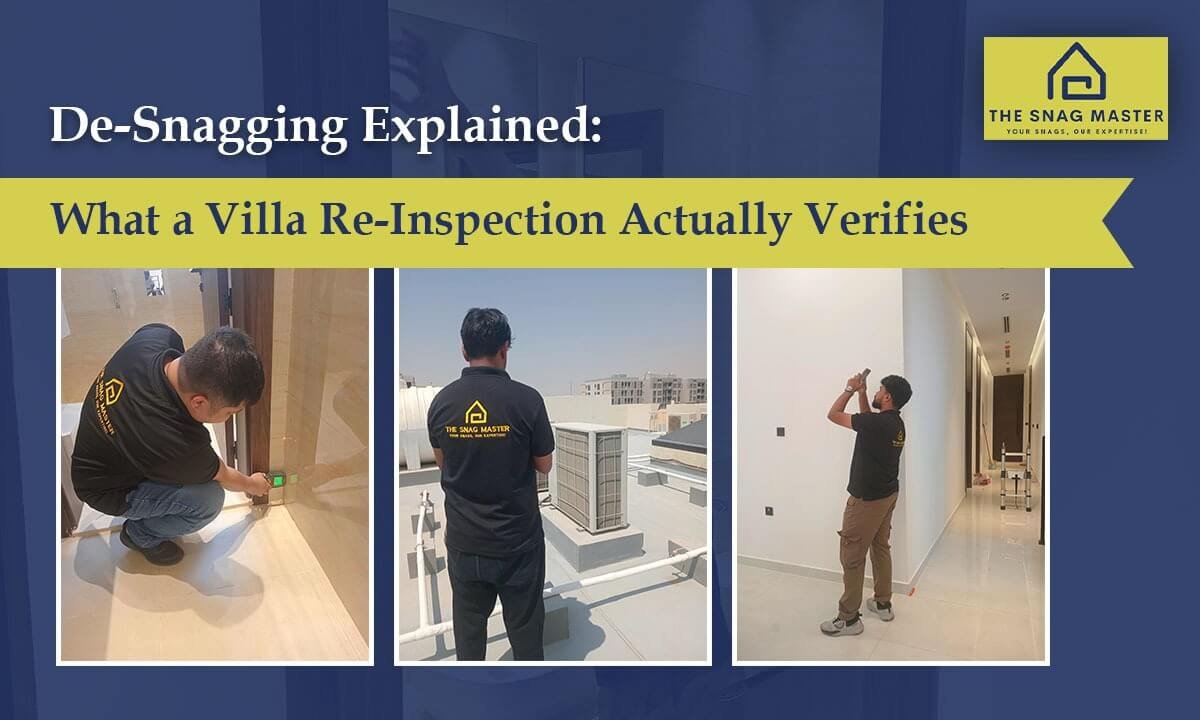
De-snagging is a second, independent inspection carried out after a developer or contractor reports that the snag list has been fixed. Every item from the first report is re-checked in the same position, photographed again, and marked Resolved or Not Resolved, with anything new recorded separately. It turns “the works are done” from a claim into evidence, while the Defects Liability Period is still running.
- A snagging inspection produces the list. A de-snagging inspection establishes what happened to it.
- Each original item is re-opened and re-photographed, and closed out on evidence rather than on a contractor’s status report.
- On the villa below, the items that closed were largely plumbing terminations and defined mechanical faults. The items that stayed open were finish work: paint, grout, tiles, door operation.
- Rectification work in a finished house leaves new marks, so the return visit records those too.
- Timing decides cost. Inside the Defects Liability Period an unresolved item is a correction instruction. After it, the same item is the owner’s maintenance bill.
The inspection, in figures
| Property | Five-bedroom villa — ground floor, first floor and roof, plus maid’s room |
| Visit 1 | Handover inspection. Villa vacant |
| Visit 2 | De-snagging re-inspection. Villa furnished |
| Scope, visit 1 | 28 areas, boundary wall to roof |
| Items inspected, visit 1 | 421 |
| Disciplines | Civil, electrical, plumbing, HVAC, plus kitchen equipment and general items |
| Report format | Every original item shown with its original photo and its re-inspection photo, marked Resolved or Not Resolved, with a separate Newly Reported section |
Two numbers are worth separating. 28 is how many areas were walked – boundary wall, backyard, garage, every ground and first floor room, the staircase, hallways and the roof. 421 is how many individual items were inspected inside those areas: not rooms, but each door, socket, drain, tile field, light fitting and air-conditioning unit within them. Scope is a function of granularity, not floor area.
What is de-snagging, and how is it different from snagging?
Three inspections get confused with one another. They sit at different points on the same timeline.
- Pre-handover snagging — before you accept the keys. Produces the original list.
- De-snagging (re-inspection) — after the rectification works are reported complete. Verifies that list.
- DLP re-inspection — near the end of the Defects Liability Period. Catches what has emerged since, while the obligation still stands.
The first two tend to collapse into a single line item in a buyer’s head. They should not. One creates the evidence; the other closes it out.
How a de-snagging report is put together
The document is deliberately built so that nobody has to be taken at their word.
- Same item, same position. Each original observation is re-opened at the exact location it was raised, using its original reference.
- Original photo beside re-inspection photo. The two images sit on the same page. The reader compares them directly.
- A binary outcome. Every item is marked Resolved or Not Resolved. There is no “in progress”, because a status is not a condition.
- Newly Reported, kept separate. Marks that were not present at the first inspection are logged in their own section, so the verification record stays clean.
That last section exists for a practical reason. Rectification in a finished, furnished house means tools, ladders and trades moving through rooms that are already complete. On this villa, the return visit picked up fresh scratching on a kitchen door, cracking on a staircase ceiling and uneven paint on a first-floor hallway wall — none of it present at handover.
What was marked Resolved
The pattern is consistent: items with a defined mechanical endpoint were the ones that closed. A termination is either made up correctly or it is not, so the repair has a finish line.
| Discipline | Observation at handover | Re-inspection |
|---|---|---|
| Electrical | Missing doorbell | Resolved |
| Plumbing | Flush button improperly terminated | Resolved |
| Plumbing | Improper termination on a drain pipe connection | Resolved |
| Plumbing | Improper termination of a spray hose angle valve | Resolved |
| Plumbing | Improper termination around a water supply angle valve | Resolved |
| Civil | Incorrect floor slope causing water ponding in a wet area | Resolved |
| Civil | Sliding window lock not engaging properly | Resolved |
| Civil | Improper termination between wall and countertop joint | Resolved |
| Civil | Inconsistent grout application between wall tile joints | Resolved |
| Civil | Uneven wall tile installation | Resolved |
| Civil | Visible joint on a door frame | Resolved |
The wet-area slope correction is the most valuable line on that list. Water ponding at a drain reads as cosmetic on handover day and presents as a ceiling stain in the room below two years later.
What was still marked Not Resolved
The open items fall into two groups, and the difference between them is the whole argument for a return visit.
Group one – finish work. High volume, low individual consequence, slow to close because it is repetitive and easy to defer.
- Paint: patches, uneven finish across walls and ceilings, peeling paint on a staircase
- Grout: inconsistent application, missing grout, dirty grout lines
- Tiles: chipped, scratched, overcut and damaged pieces, damaged skirting, improper finishing above skirting
- Terminations: between wall and door frame, window frame, curtain wall frame, and between floor tiles and curtain wall
- Cracking: on walls, the boundary wall, the roof floor, and around vent pipe penetrations at the parapet
- Surface condition: rust build-up on manhole covers, scratches and stains on door frames and window frames
Group two – operational and service items. Lower volume, higher consequence, and the reason an owner pays for verification rather than taking a sign-off at face value.
- Doors not closing properly, rattling in the frame, improper latch termination, improper door stopper installation
- Open and disconnected electrical conduits at more than one location
- Exposed wires from a poorly terminated conduit
- A conduit secured to an insulated water supply pipe with masking tape, and improper sealing around a conduit entry at a service shaft
- A loose outdoor light fitting, and a roof light fitting missing its cover
- Water heater relief drain pipes not correctly run
- Sockets not aligned
- Air-conditioning units not properly secured to their mounting pads
- Dirty fins on the air-conditioning condenser units
Read the two groups together and the commercial point makes itself. The first group is what an owner can see and will eventually chase. The second group sits on the roof, inside a service shaft, behind a ceiling or under a cover — and it is the group that quietly lifts running costs, shortens equipment life, or matters on the day something goes wrong.
Why the furniture changed the inspection
At the first visit the villa was empty. Every wall, floor and skirting line was open to inspection.
At the second it was furnished. That is normal, and it is the owner’s right — but it has a measurable effect on coverage. Anything behind a wardrobe, under a sofa or inside a fitted unit cannot be assessed, and a competent report records it as not inspected with the reason stated rather than implying coverage it did not have.
The practical conclusion: book the return visit for the window between “the contractor says it is finished” and “the removal van arrives”.
When should you book a de-snagging inspection?
- After rectification is reported complete. The purpose is verification, so there has to be something to verify.
- Before furniture and fit-out go in. Coverage is at its maximum while the property is empty.
- Before releasing any retained payment. A shortfall is a correction instruction while money is still held, and a claim afterwards.
- Before the Defects Liability Period expires. Installations, workmanship and MEP systems typically carry a one-year period from handover under the sale and purchase agreement. The structural clock is separate and much longer.
(General information, not legal advice — the terms of your own SPA govern your position.)
Frequently asked questions
1.What is a de-snagging inspection?
A de-snagging inspection is a second independent inspection carried out after the developer or contractor reports that the original snag list has been fixed. Each item is re-checked in the same place, photographed again, and marked Resolved or Not Resolved by an engineer.
2.What is the difference between snagging and de-snagging?
Snagging creates the list of defects before handover. De-snagging verifies that list once rectification works are complete. One produces the evidence; the other closes it out. Most buyers budget for the first and skip the second.
3. Do I need de-snagging if the developer confirms the work is done?
A confirmation records that work was attempted. A re-inspection records the condition of each item. On the villa described here, closed items and open items sat side by side on the same list, which is only visible once somebody returns and checks.
4. When is the best time to book a de-snagging inspection?
After the works are reported complete, before furniture is moved in, and always inside the Defects Liability Period. An empty property allows full access to walls, floors and skirting lines; a furnished one does not.
5. What happens if an item is still not resolved?
It is recorded as Not Resolved with both photographs attached and remains an open item against the developer or contractor for as long as the liability period runs. The documented record is what makes the item actionable rather than arguable.
6. Does de-snagging cover new defects found on the return visit?
Yes. New marks are logged in a separate Newly Reported section so the verification of the original list stays clean. Repair work in a finished property commonly leaves fresh scratches, cracks or paint marks behind.
7. How long is a developer liable for defects in the UAE?
Installations, MEP systems and workmanship usually carry a one-year defects liability period from handover under the sale and purchase agreement, while structural liability runs far longer under UAE decennial liability rules. Most of what an inspection finds falls inside the shorter window.
8. Can I de-snag the property myself?
You can re-check obvious cosmetic items. What a buyer cannot reasonably assess is conduit termination inside a service shaft, how an air-conditioning unit is fixed to its pad, how a water heater relief drain is run, or what sits above a false ceiling. That is where the consequential items were found.
9. Is de-snagging only for villas?
No. The same method applies to apartments, commercial fit-outs and whole buildings. The number of areas and items scales with the property; the verification logic does not change.
Great design is just the start. Quality assurance is the finish line.
The Snag Master is a RERA-certified, DED-licensed property inspection company. Inspections are carried out by InterNACHI-certified civil engineers working to RERA Standards of Practice, across Dubai, Abu Dhabi and the wider UAE.
Pre-handover snagging · de-snagging and DLP re-inspection · interior fit-out inspection · Building Condition Audit · move-in / move-out inspection.