
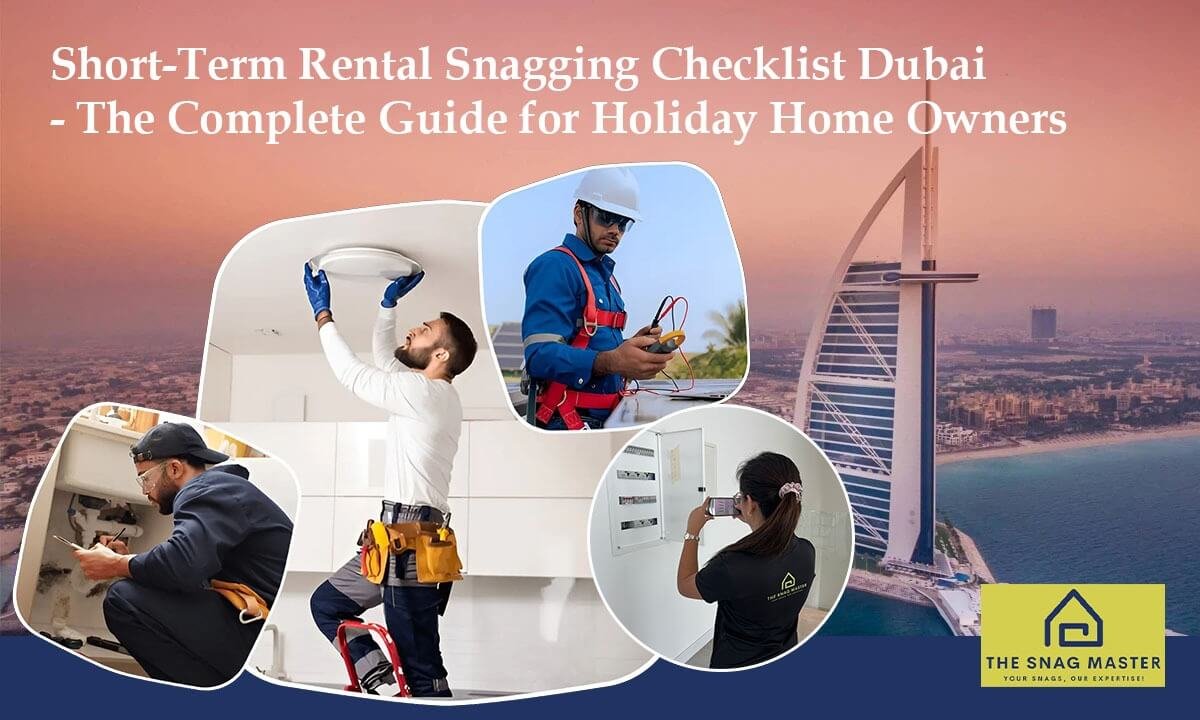
Your Dubai Holiday Home Is Listed. But Is It Actually Guest-Ready?
Most Dubai holiday home operators invest in interior design, professional photography, and smart pricing. Far fewer invest in the one thing that protects all of it: a professional snagging inspection before the first guest checks in.
A defective AC unit. A leaking tap. A bathroom fan that doesn’t clear moisture. A non-functional socket. Individually, each seems minor. To a guest who has paid premium rates and expects everything to work – each one is a potential negative review, a refund request, and a platform ranking penalty.
This guide covers exactly what a short-term rental snagging inspection checks – and why getting it right before your first booking is far less expensive than getting it wrong after.
Why Short-Term Rental Snagging Is Different From Standard Snagging
Standard snagging focuses on construction defects inherited from the developer. Short-term rental snagging goes further – combining defect identification with a guest-readiness assessment that evaluates the property through the eyes of a paying guest expecting hotel-quality standards.
There is also a compliance dimension. The Department of Economy and Tourism (DET) oversees all short-term rental activity in Dubai. Every furnished apartment or villa rented for stays under six months requires a valid DET Holiday Home Permit – enforced through platform monitoring and inspections. Operating without one risks fines from AED 5,000 to AED 100,000.
A professional snagging inspection prepares your property for both: the guest’s experience and the regulator’s requirements.
The Short-Term Rental Snagging Checklist
1. Structural Finishes and Interior
Guests notice imperfections immediately – and platforms give them a public forum to record them.
- Walls and ceilings: Check for cracks, damp patches, water staining, and paint inconsistencies. In Dubai’s humid climate, moisture ingress behind wall finishes is frequently missed at a glance.
- Flooring: Inspect all tiles, vinyl, and laminate for hollow tiles, lifted edges, chipped corners, and poorly sealed thresholds. Hollow tiles are a safety issue, not just cosmetic.
- Doors and windows: Test every door for alignment, correct latching, and functioning locks. Balcony doors and windows must seal fully against the UAE’s extreme summer heat.
2. Electrical Systems
Electrical defects are not just inconveniences – they are safety and compliance risks.
- Test every socket and light switch throughout the property. Non-functional sockets are among the most reported guest complaints in Dubai short-term rentals.
- Check all light fittings – ceiling, bathroom, balcony – for correct installation and full function.
- Inspect the distribution board for correct labelling and all breakers in operational position.
- Air conditioning: In Dubai, AC is infrastructure, not an amenity. Test every unit for cooling performance, drainage integrity, filter condition, and thermostat accuracy. HVAC failures are the most common guest complaint during summer months.
3. Plumbing and Water
- Test all taps, showers, and mixers for correct hot/cold function and adequate water pressure. Dripping or leaking taps are among the most common findings in newly handed-over Dubai apartments.
- Inspect toilets, basins, and baths for correct flush, secure fixings, and properly applied sealant.
- Run all drains and confirm water clears within an acceptable timeframe. Slow drainage from debris in pipework is a frequent post-handover finding.
- Test the water heater for adequate hot water supply across all fixtures.
4. Kitchen
- Test every supplied appliance – hob, oven, microwave, dishwasher, refrigerator, and washing machine – for full function. Non-functional appliances generate immediate review damage.
- Check all kitchen units for correct door operation, functioning hinges, and properly applied worktop edges.
- Test the extractor fan for operational extraction. Kitchen extractors are frequently installed but not connected in new Dubai builds.
- Inspect kitchen tiling for hollow tiles, cracked grout, and unsealed joints around the hob and sink.
5. Bathrooms and Wet Areas
Bathrooms are the highest-scrutiny area for short-term rental guests. Any defect here directly affects review scores.
- Waterproofing: The most critical – and most commonly defective – element. Poorly applied membrane behind shower tiles causes water ingress that can take months to appear visibly but causes significant structural damage in a high-use holiday home. The Snag Master uses moisture detection equipment to identify failures behind completed tile finishes without surface damage.
- Ventilation: Bathroom extract fans must be functional and correctly ducted. Inadequate ventilation causes mold growth in Dubai’s humidity – a guest-facing hygiene issue.
- Fittings: Towel rails, shower screens, and bathroom accessories must be securely fixed. Items that move or fall generate immediate negative feedback.
6. Furnishings and Guest-Readiness
- All furniture should be structurally sound and consistent with listing photography. Guests encountering furniture that differs from images have grounds for platform complaints.
- Curtains and blinds must fully cover windows and operate correctly. Blackout provision in bedrooms is expected at quality Dubai holiday home standards.
- Test all smart systems, keyless entry locks, TV and entertainment systems, and Wi-Fi connectivity. Technology failures are disproportionately represented in negative reviews.
What Happens When Defects Are Found?
For recently handed-over Dubai properties, defects identified within your defect liability period are typically rectifiable at the developer’s cost – not yours. The Snag Master’s inspection report provides photographic evidence, precise defect locations, and severity classifications – a professionally prepared record suitable for developer rectification requests, property managers, and DET inspectors.
How The Snag Master Inspects Short-Term Rental Properties
Every inspection goes beyond a visual walkthrough. Our InterNACHI-certified Civil Engineers use moisture detection, thermal imaging, and non-destructive testing to uncover what visual checks miss – particularly in bathrooms, behind wall finishes, and within electrical systems.
Reports follow RICS methodology – photographically evidenced, defect-mapped, severity-classified, and structured for clear rectification action. We are RERA Certified and DED Licensed, operating across Dubai and all seven UAE Emirates.
Don’t let your first guest become your first negative review.
Book your inspection now
connect@thesnagmaster.ae | +971 058 599 1704 RERA Certified | DED Licensed | InterNACHI Engineers | RICS Methodology
Frequently Asked Questions
- Why snag a holiday home if it’s newly handed over?
New Dubai properties frequently contain defects invisible during a standard walkthrough – MEP faults, waterproofing failures, incomplete installations. A professional inspection identifies these before guests encounter them, and while many remain within the developer’s DLP window.
2. What is a DLP, and how does it benefit a holiday home owner during snagging?
The Defect Liability Period (DLP) is a 12-month developer warranty post-handover. A professional snagging report during this window forces the developer to fix defects—like AC or plumbing faults – for free, saving you thousands before guests check in.
3. How long does a short-term rental inspection take?
A standard Dubai apartment inspection takes 1.5 to 3 hours depending on size. The full report is delivered within 24 to 48 hours.
4. What areas of Dubai do you cover?
We inspect all Dubai areas including Dubai Marina, Downtown, Palm Jumeirah, JBR, Business Bay, DIFC, Dubai Hills, Arabian Ranches, and all residential communities.