
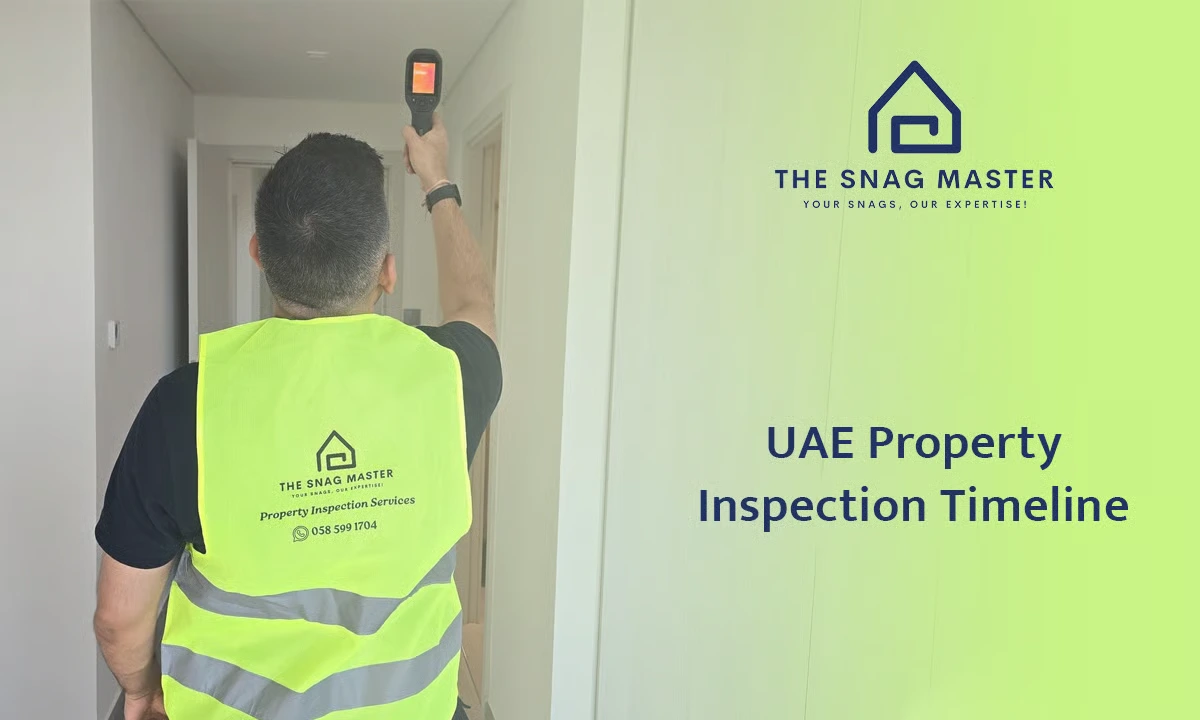
The right time to inspect a property in the UAE is at five points in its life: before you buy (resale), immediately after the developer’s handover notification (snagging), after any renovation or fit-out, 10-11 months after handover (Defect Liability Period inspection), and once every 12 months after that (preventive inspection). Each one catches a different type of defect at a moment when someone else is still responsible for paying to fix it. Booking on time can mean the developer or contractor repairs issues at their cost. Booking late can mean you pay for them yourself. The Snag Master’s civil engineers carry out every inspection in this timeline across Dubai, Abu Dhabi and all seven emirates, with a photographic, severity-ranked report delivered within 24 hours.
The UAE Property Inspection Timeline at a Glance
| Stage | When to book | What it protects you from | Who pays for repairs |
|---|---|---|---|
| 1. Pre-purchase inspection (resale) | Before signing the MOU or transfer | Buying hidden defects, leaks or mold | Negotiated with the seller |
| 2. Handover snagging | Straight after the handover notification, before signing acceptance | Construction defects and unfinished work | Developer |
| 3. De-snagging | After the developer says repairs are done | Repairs marked “closed” but not fixed | Developer |
| 4. Post-renovation inspection | Before final payment to the contractor | Poor workmanship, wrong materials, unsafe MEP | Contractor |
| 5. DLP inspection | Month 10-11 after handover | Defects that only show after months of living there | Developer (if reported within the DLP) |
| 6. Annual preventive inspection | Every 12 months | Slow leaks, cracks, AC and safety issues | Owner (but cheaper to fix early) |
| 7. Move-in / move-out inspection | On tenancy start and end | Deposit disputes | Tenant or landlord, based on evidence |
1. Pre-Purchase Inspection: Before You Commit to a Resale Property
When: After your offer is accepted and before you transfer the money or complete the transfer.
Resale properties have no developer warranty left to fall back on, and defects that exist at the time of purchase become yours. A pre-purchase inspection checks structure, waterproofing, MEP systems, AC performance and signs of hidden moisture or mold. Thermal imaging and moisture meters find problems behind walls and ceilings that a visual viewing misses.
What you gain: A documented condition report you can use to negotiate the price down, ask the seller to repair, or walk away.
2. Handover Inspection (Snagging): The Most Important Booking You’ll Make
When: As soon as you receive the developer’s handover notification, and before you sign the acceptance or handover form.
Developers handle large numbers of handovers, and rushed completion is common. Snagging is an independent inspection that records every construction defect and finishing fault so the developer fixes them before you take ownership. On average, The Snag Master finds 150+ snags in apartments and 265+ in villas.
What a professional snagging inspection covers
- Structure and finishes: wall and ceiling cracks, tiling and grout, paintwork, joinery, flooring
- Doors and windows: alignment, seals, locks, insulation
- MEP systems: electrical circuits and sockets, plumbing and drainage, AC performance
- Waterproofing and moisture: balconies, bathrooms, external walls, using thermal imaging and moisture detection
- Safety items: fire and life-safety provisions, handrails, ventilation
Why timing matters
Developers usually give buyers a limited window after the handover notice, and service charges may start counting from that point. Check your Sales and Purchase Agreement (SPA) for the exact terms. Booking straight away leaves time for the inspection, the developer’s repairs and de-snagging before you sign. Once you accept the unit, arguing that a defect existed at handover becomes much harder.
See our full guide: Snagging vs De-Snagging in Dubai.
3. De-Snagging: Verifying the Developer’s Repairs
When: After the developer confirms the snag list has been rectified.
De-snagging is the re-inspection that checks each item was genuinely fixed, not just marked closed. Any unresolved or badly repaired item goes into a new report for the developer. Use the same inspector as for the original snagging, so each item is compared against the original evidence.
4. Post-Renovation Inspection: Before You Pay the Contractor in Full
When: When the contractor says the work is finished, and before the final payment or retention release.
Renovations and interior fit-outs in the UAE are often fast-tracked, and different trades (electrical, plumbing, carpentry, AC) work on the same space. A post-renovation inspection checks that the work matches the agreed scope and specification and meets basic quality and safety standards.
Common issues we look for
- Electrical and plumbing work that is hidden, untidy or non-compliant
- Poor tiling, waterproofing and paint finishes
- Ceiling, partition and joinery defects
- AC ducting and ventilation problems after modification
- Unfinished items and materials that differ from the quotation
Inspecting before the final payment keeps your negotiating leverage. For commercial spaces, this stage is the same as an interior fit-out inspection.
5. DLP Inspection: Your Last Free-Repair Window (Month 10-11)
When: 10-11 months after handover, in time to report defects before the Defect Liability Period ends.
Most new UAE properties come with a developer Defect Liability Period, commonly 12 months, though the exact length and terms depend on your SPA and developer. Some defects only appear after months of living in a home: seepage, cracks from settlement, AC drainage problems, failing sealants and joinery movement.
Reporting them within the DLP is what makes the developer responsible for repairs at their cost. Booking at month 10-11 leaves time to inspect, report and get a response before the period closes.
Also worth knowing: The DLP covers non-structural defects. Structural defects are covered by a separate, much longer statutory liability under the UAE Civil Code (commonly cited as 10 years). Confirm your specific position with your developer or a legal adviser.
Book a DLP inspection through our residential property inspection service or, for offices and retail units, our commercial property inspection service.
6. Annual Preventive Inspection: Catching Problems Before They Get Expensive
When: Every 12 months, and before and after each summer if you own a villa.
The UAE’s heat, humidity and constant AC use put unusual stress on buildings. Small leaks and condensation can turn into mold, damaged ceilings and failed equipment. A yearly check catches these early and is especially valuable for:
- Landlords and investors who don’t visit the property regularly
- Holiday-home owners whose units sit empty for months
- Villa owners with gardens, pools and external waterproofing to maintain
It also builds a dated condition record, which supports your case in insurance and tenancy disputes.
7. Move-In and Move-Out Inspections: Ending Deposit Disputes
When: On the day a tenancy starts and again when it ends.
A dated, photographed condition report protects both tenant and landlord from disputed damage claims. It separates normal wear and tear from actual damage, and a dispute that would take weeks to argue becomes a document you can point to.
How to Use This Timeline: Quick Scenarios
- Buying off-plan: Stages 2, 3, 5 and 6. Diary the DLP inspection the day you get your keys.
- Buying resale: Stages 1, 4 (if you renovate) and 6.
- Renovating an existing home: Stage 4, then 6.
- Landlord or investor: Stages 7 and 6, plus stage 5 if the property is still under DLP.
- Commercial tenant or owner: Stages 2 or 1, then 4 (fit-out) and 6.
Why Choose The Snag Master for Every Stage
- Qualified civil engineers, not general technicians, following the RICS code of practice
- Thermal imaging and moisture detection as standard
- RERA-certified and InterNACHI-accredited
- Photographic, severity-ranked report within 24 hours, ready to send to your developer or contractor
- One team across the whole timeline, so de-snagging and DLP checks refer back to earlier findings
- All seven emirates: Dubai, Abu Dhabi, Sharjah, Ajman, Ras Al Khaimah, Umm Al Quwain and Fujairah
Frequently Asked Questions
1. When should I book a snagging inspection in the UAE?
Book as soon as you receive the developer’s handover notification and before you sign the acceptance form. This leaves time for the developer to fix defects and for a de-snagging check before you take ownership.
2. How long is the defect liability period in Dubai?
The DLP on most new UAE properties is commonly 12 months from handover, but the exact length and terms depend on your Sales and Purchase Agreement and developer. Check your contract to confirm.
3. When should I do a DLP inspection?
At 10-11 months after handover. This gives you time to inspect, submit your report and get repairs done before the DLP closes.
4. Who pays for defects found during the DLP?
If defects are reported within the DLP and fall within the developer’s responsibility, the developer is normally required to fix them at their cost. Defects reported after it ends usually become the owner’s cost.
5. Is a post-renovation inspection necessary?
It is strongly recommended. It checks that the contractor’s work matches the agreed scope and is safe before you release final payment.
6. How often should I inspect my property in the UAE?
At key milestones (purchase, handover, after renovation, DLP), then annually. Owners of villas, empty holiday homes and rental investments benefit most from yearly checks.
7. What is the difference between snagging and a DLP inspection?
Snagging happens before handover and finds construction defects in a new unit. A DLP inspection happens near the end of the warranty year and finds defects that only appeared after you moved in.
8. Do I need an inspection for a resale property?
Yes. Resale properties usually have no developer warranty left, so hidden defects become your responsibility. A pre-purchase inspection gives you evidence to negotiate.
9. Does The Snag Master inspect properties outside Dubai?
Yes. We cover all seven emirates for residential, commercial and off-plan properties.
10. How quickly will I get my inspection report?
Within 24 hours of the inspection, with photos and each defect ranked by severity.
Don’t wait until the warranty runs out.
Whether you’re about to take handover, finishing a renovation or approaching month 10 of your DLP, book with The Snag Master’s civil engineers. RERA-certified, covering all seven emirates, report in 24 hours.