
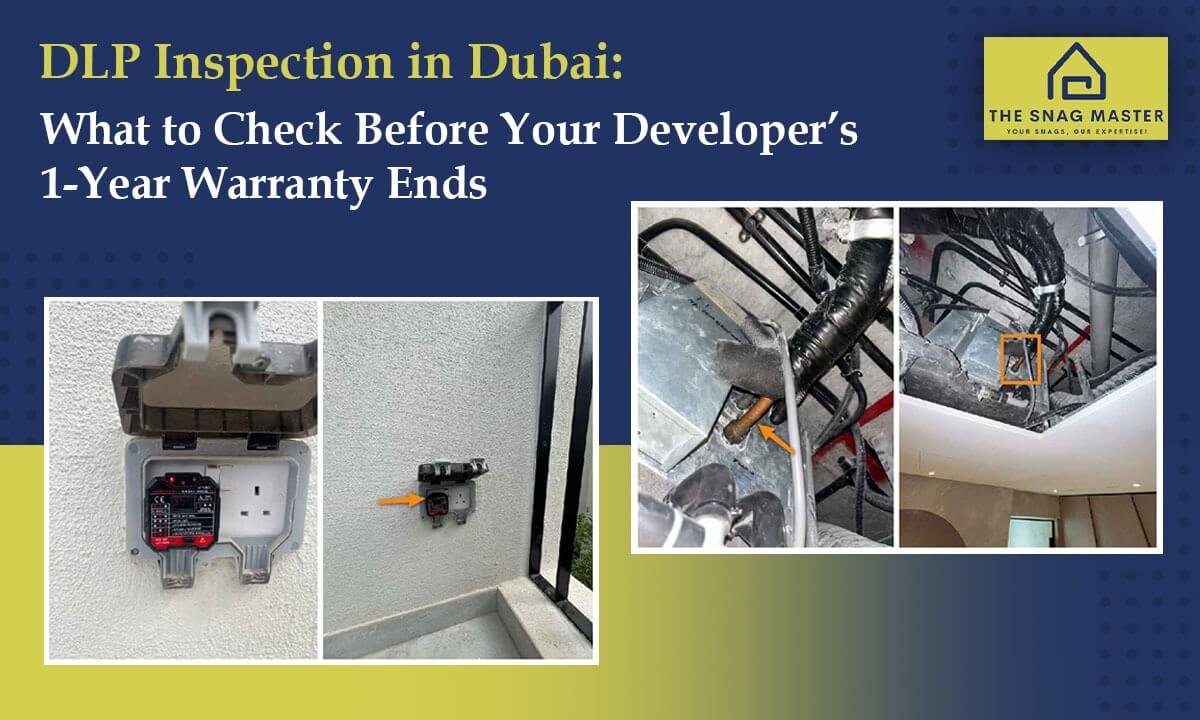
A DLP inspection in Dubai is an engineer’s check of your home before the developer’s 1-year Defects Liability Period (DLP) ends. Under Dubai Law No. 6 of 2019, Article 40, developers must repair faulty installations (mechanical, electrical, plumbing and drainage) for 1 year from the day the unit is handed over, and defects in the main structure for 10 years from the project’s completion certificate. A DLP inspection finds faults while fixing them is still the developer’s job, at no cost to you.
the 1-year clock starts when you get your keys. Anything not reported before it stops is usually yours to fix.
Key takeaways
- The DLP for installations (AC, electrical, plumbing, drainage) is 1 year from handover.
- Structural defects are covered for 10 years from the completion certificate.
- Book your DLP inspection around months 9 to 11 after handover.
- The most serious faults are often hidden: above ceilings, behind covers and outside the home.
- Send the inspection report to your developer before the 1-year date.
How long is the developer warranty in Dubai?
There are two time limits under Dubai law, and they start at different points.
| What’s covered | How long | Starts from |
|---|---|---|
| Installations: AC, electrical, plumbing, drainage | 1 year | The day the unit is handed over to you |
| The main structure (foundations, columns, structural walls, roofs) | 10 years | The date of the project’s completion certificate |
Two things worth knowing:
- The 1-year clock is the short one. Most everyday faults, like a socket, a leaking joint or an AC unit that isn’t draining properly, fall under it.
- If you delay taking the keys, the 1-year period can start from the completion certificate instead. Waiting doesn’t always buy you more time.
What is a DLP inspection?
A DLP inspection is a full check of a home that has already been lived in for some months, carried out before the 1-year period ends. It’s also called an end-of-warranty inspection or a re-snagging inspection.
It looks for two kinds of problems:
- Faults that weren’t fixed from the original handover snagging list.
- Faults that appeared later, once the AC, water and electrics have been used every day. Small leaks, loose fittings and electrical faults often only show after a few months of use.
The result is a report with a photo and a short note for each finding, which you send to the developer as your repair request.
Handover snagging vs DLP inspection: what’s the difference?
| Handover snagging | DLP inspection | |
|---|---|---|
| When | Before or at handover | Around months 9 to 11 after handover |
| Home condition | Empty, systems barely used | Lived in, systems used every day |
| What it finds | Build and finishing defects | Unfixed snags plus faults that appear with use |
| The goal | Get faults fixed before you move in | Get faults reported before the 1-year cover ends |
If you had a handover inspection, the DLP inspection also checks whether those items were actually fixed.
When should I book a DLP inspection?
Around months 9 to 11 after handover.
- Earlier than that, some faults haven’t had time to show.
- Later than that, there may not be enough time to send the report and get repairs booked before the year is up.
| Time after handover | What to do |
|---|---|
| Day 1 (keys) | The 1-year DLP clock starts. Keep your handover documents safe. |
| Months 1 to 8 | Live in the home. Photograph and date anything that goes wrong. |
| Months 9 to 11 | Book your DLP inspection and send the report to the developer. |
| Month 12 | The 1-year cover for installations ends. |
| Up to year 10 | Structural cover continues, counted from the completion certificate. |
Check your handover date now. It’s on your handover documents. Count forward 12 months, and book the inspection a couple of months before that date.
What does a DLP inspection find?
These are typical findings from our recent DLP reports, in homes that looked fine day to day:
- Exposed, unterminated wires outside the home at ground level. Marked as a safety hazard.
- Bare wires where the cable conduit ends, above hallway and bathroom ceilings. Also marked as safety hazards.
- Sockets with no earth connection. The socket works, so you’d never know. A socket tester picks it up.
- Damaged insulation on AC refrigerant pipes above bathroom ceilings.
- Water heaters without a proper drain pipe on the safety valve.
- Doors, cabinets and sliding doors that stick or don’t close properly.
Why it matters: most of these sit above the ceiling, behind a cover or outside. They’re easy to miss when you live in the home, and they’re things the developer must fix if they’re reported in time.
DLP inspection checklist: what engineers check
Our engineers check the home room by room using thermal imaging cameras, moisture meters and socket testers. A full DLP inspection covers:
- Electrical: socket earthing and wiring, the distribution board, safety switch (RCD) tests, light fittings, outdoor sockets, and exposed wiring above false ceilings.
- Plumbing and drainage: leaks under sinks and behind fittings, water pressure, drain flow, water heater safety valves, and sealing around baths and showers.
- AC (HVAC): cooling in every room, condensate drainage, fan coil units, and insulation on refrigerant pipes.
- Civil works and finishes: cracks, hollow or loose tiles, grout, paint, and hidden damp in walls and ceilings.
- Doors, windows and joinery: alignment, locks, sliding door tracks, window seals and cabinet hinges.
- Kitchen equipment supplied with the home.
- Outside areas (villas and balconies): external wiring, drainage, waterproofing and outdoor fittings.
Can I do a DLP check myself?
You can catch the obvious things: a door that sticks, a tap that drips, a crack in the paint. Our 10-minute self-check shows you how.
What you can’t easily check is what’s hidden: wiring above ceilings, earth connections, AC pipes and drains, and damp inside walls. Those need an engineer and the right tools.
What happens after the DLP inspection?
- You get the report, with a photo and a short note for each finding.
- Send it to the developer as your repair request, before the 1-year date.
- The developer books the repairs.
- Optional: a re-inspection to confirm the repairs were done properly.
The bottom line: report a fault inside the year, and fixing it is the developer’s job. Find it after, and it’s usually yours.
Frequently asked questions
What is the Defects Liability Period (DLP) in Dubai?
It’s the time after handover when the developer must fix faults at no cost. Under Dubai Law No. 6 of 2019, Article 40, installations such as AC, electrical, plumbing and drainage are covered for 1 year from handover, and the main structure for 10 years from the project’s completion certificate.
When does the 1-year DLP start?
From the day the unit is handed over to the owner. If the owner doesn’t take handover, it can start from the date of the completion certificate instead.
What is a DLP inspection?
An engineer’s full check of a home before the 1-year period ends. It finds faults that weren’t fixed at handover and new ones that appeared with daily use, and gives you a photographed report to send to the developer.
When should I book a DLP inspection?
Around 9 to 11 months after handover. That leaves time to send the report and get repairs done before the year is up.
What is the difference between snagging and a DLP inspection?
Snagging is done at handover, in an empty home, to catch build and finishing defects. A DLP inspection is done near the end of the first year, in a lived-in home, to catch unfixed snags and faults that appeared with daily use.
Can I have a DLP inspection while I’m living in the home?
Yes. DLP inspections are often done while the family is living there. Engineers check what is reachable and note anything they couldn’t access, with the reason.
What happens if I find a fault after the DLP ends?
Faults in installations found after the 1-year period are usually the owner’s cost. Structural defects are covered for 10 years from the completion certificate. Check your sale agreement, as it may give extra cover.
Who carries out The Snag Master’s DLP inspections?
InterNACHI-certified civil engineers, using thermal cameras, moisture meters and socket testers. The Snag Master is RERA certified and DED licensed, and inspects apartments, villas and commercial property across Dubai and the UAE.
Book your DLP inspection
Great design is just the start. Quality assurance is the finish line.
Is your first year nearly up? Have your home inspected while repairs are still the developer’s job.
connect@thesnagmaster.ae · +971 58 599 1704 · thesnagmaster.ae