
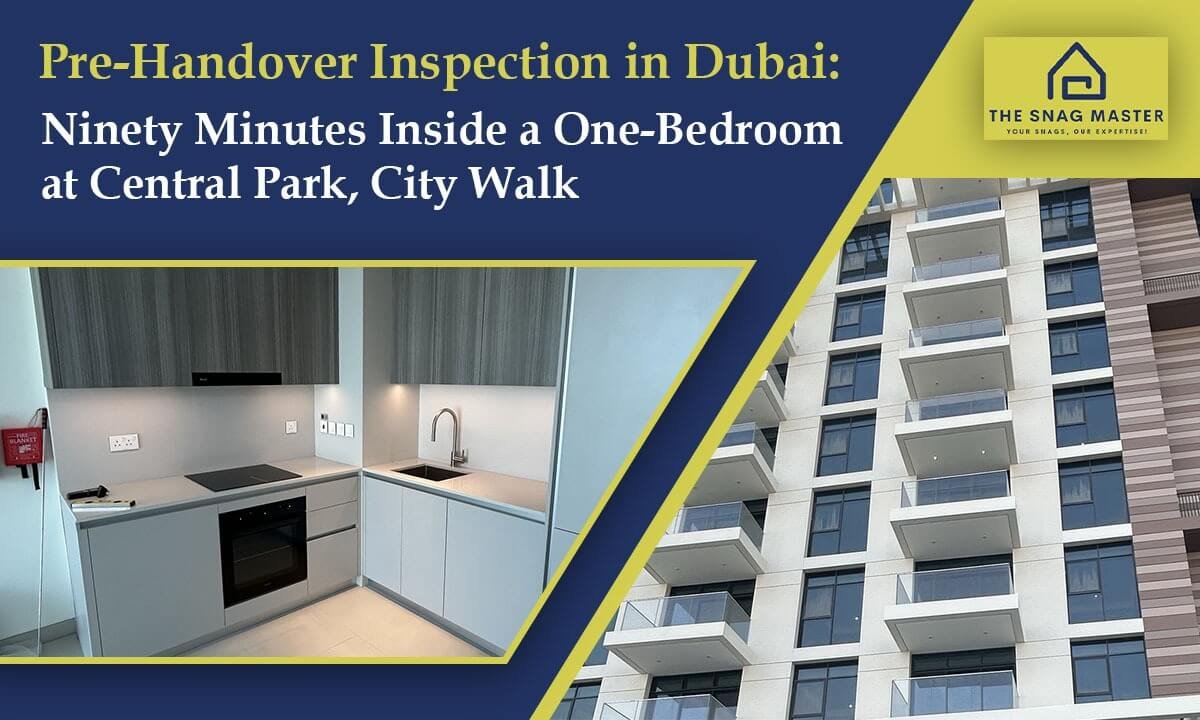
A pre-handover inspection is an independent examination of a newly built property carried out before the buyer signs for the keys, so that anything needing attention is recorded while responsibility for it still sits with the developer and the contractor.
This article walks through one of them in full:
- Property: a one-bedroom apartment at Central Park, City Walk, Dubai
- Team on site: 01 InterNACHI-certified civil engineer
- Time on site: 1.5 hours
- Sections walked: 08, entrance to balcony
- Recorded: observations against 20 components across three disciplines — architectural, interior fit-out and MEP
- Output: a 34-page report with a site photograph against every observation, each one pinned to the floor plan
What is a pre-handover inspection?
A pre-handover inspection — commonly called snagging – is an independent, engineer-led check of a newly completed property, carried out before the buyer accepts the keys.
Its purpose is narrow and specific: to record the condition and workmanship of the unit against the standard the buyer is entitled to receive, in writing, with photographs, at the one moment when the developer and the contractor are both still on the hook.
It is not a valuation. A valuation establishes price. It is not a structural survey of the building. It is a record of what the buyer is being handed.
The property: Central Park at City Walk, Dubai
| Property type | One-bedroom apartment |
| Location | Central Park at City Walk, Al Wasl — Dubai |
| Inspection type | Pre-handover snagging inspection |
| Engineer on site | 01, InterNACHI-certified civil engineer |
| Duration | 1.5 hours |
| Sections walked | 08 |
| Components with observations recorded | 20, across 3 disciplines |
| Report issued | 34 pages, photo-referenced, pinned to the floor plan |
Central Park is a masterplan community at City Walk, in Al Wasl. Its residential towers run to around twelve storeys, holding one- to four-bedroom apartments arranged around the park the community takes its name from. Downtown Dubai is roughly nine minutes away by car.
Why the handover window is the one that matters
That context is not decoration. A building in its handover phase behaves differently from a building three years in.
Shared services are still being commissioned. Fit-out teams are still moving between floors. Water has often only recently been through the pipework in anger. An engineer arriving on a handover morning is reading a building that has not yet settled into itself – and that is exactly the window in which observations are cheapest to resolve.
Why it matters: an apartment handed over inside a live construction envelope carries different risks from a resale. The inspection has to account for both the unit and the state of the building around it.
There is also a clock. Under Dubai’s property framework, a developer carries a ten-year liability for structural elements from the date of the completion certificate, and a one-year liability on mechanical and electrical installations from unit handover. The second of those two periods is short, and it starts the moment you sign.
First: the drawing comes out before anything else
The first thing out of the bag is not a torch. It is the general arrangement plan for the floor.
Before a single surface is examined, the engineer orients the unit: where the wet areas sit relative to one another, where the chilled-water riser runs, which walls are shared, which face the façade, where the drainage falls.
The plan sets the route. It also sets the filing system — because every observation recorded over the next ninety minutes will be pinned back onto that same drawing by position, not by paragraph number.
That is the quiet difference between a list and a report. A list tells you what was found. A plan tells the contractor where to stand.
The route: eight sections, in sequence
- Entrance — the threshold, the first door set, the first tile bed
- Corridor — the circulation spine, and the ceiling above it
- Living / dining — the largest single field of finishes in the apartment
- Kitchen — joinery, splashback, cabinetry, appliances, and the water that feeds them
- Utility — small, wet, and routinely the least-finished room in a handover
- Master bedroom — glazing, shutters, wall finishes, door hardware
- Master bathroom — the densest section of the walk, every time
- Balcony — falls, drainage, balustrade, and the seal between inside and out
Nothing is skipped because it looks finished. The tempo is deliberately even: a room that presents perfectly still gets the same pass as one that obviously doesn’t.
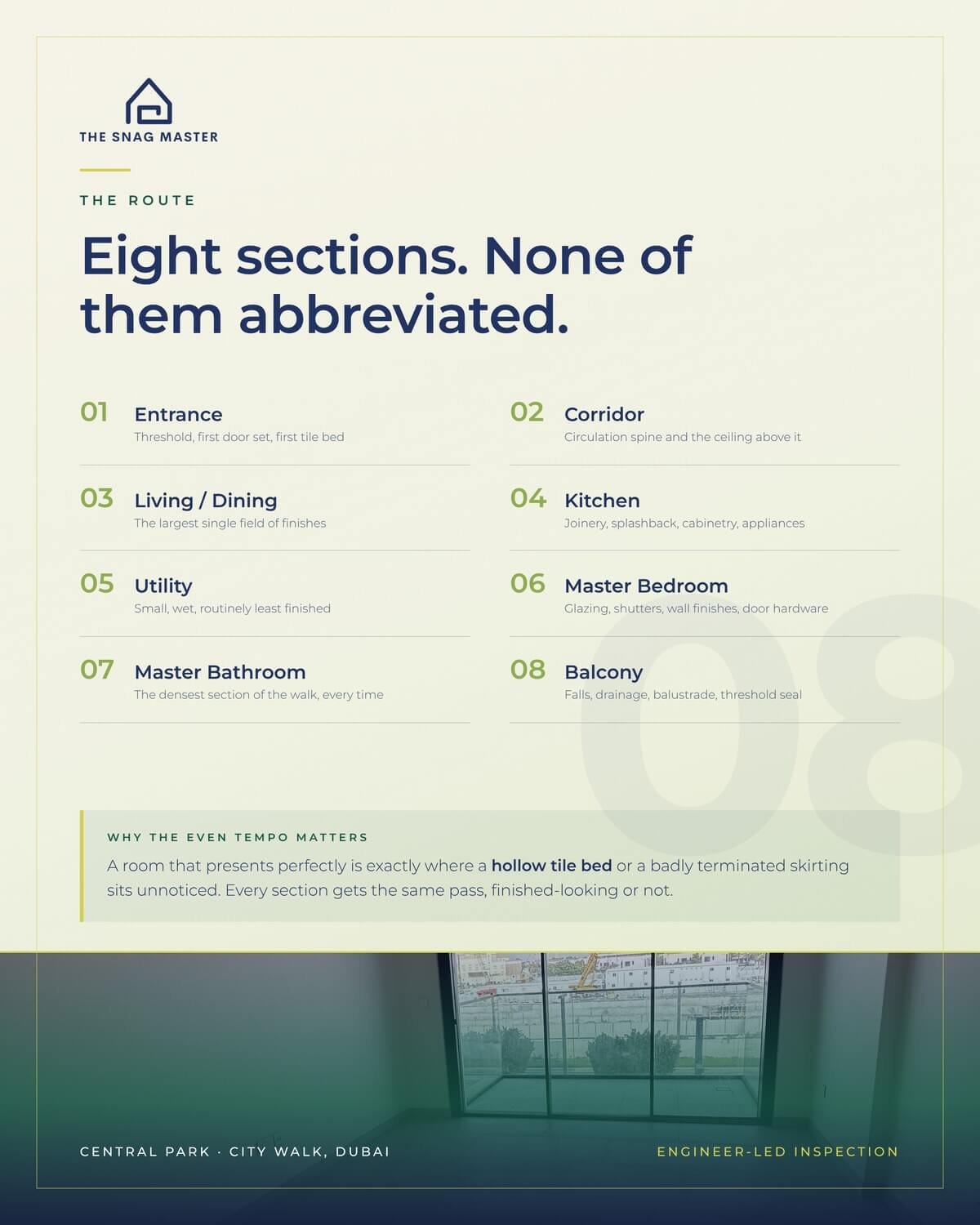
The eight sections covered in a one-bedroom apartment snagging inspection
What the walk actually recorded
Across those eight sections, observations were recorded against 20 distinct components, spanning all three of the report’s disciplines.
ARCHITECTURAL — 14 COMPONENTS
Aluminium sliding doors · windows · balustrade · ceramic floor tiling · ceramic skirting · wall tiling · wall surfaces · paint finishes · false ceilings · internal doors (frames, architraves, hinges, hardware) · floor cabinets · wall cabinets · kitchen installation · floor drain
INTERIOR DESIGN — 3 COMPONENTS
Wash basin · vanity cabinet · stone splashback
MEP-MECHANICAL — 3 COMPONENTS
Water heaters · HVAC (fan coil unit and its panel box) · condensate drain pipe
The MEP line: what a visual walk-through never produces
Those last three are the ones that separate an engineer from an enthusiastic eye.
Hot water was run at the outlets and found insufficient at the time of inspection. The bathroom ceiling was checked for moisture where the condensate line passes above it. The fan coil unit filter was accessed and examined, and the panel box beside it was recorded open.
None of that is visible to someone walking through with a phone torch. All of it is the kind of thing that becomes a service call eighteen months later.
The point: finishes are what a buyer notices on a viewing. Services are what a buyer lives with. A handover inspection has to reach both.
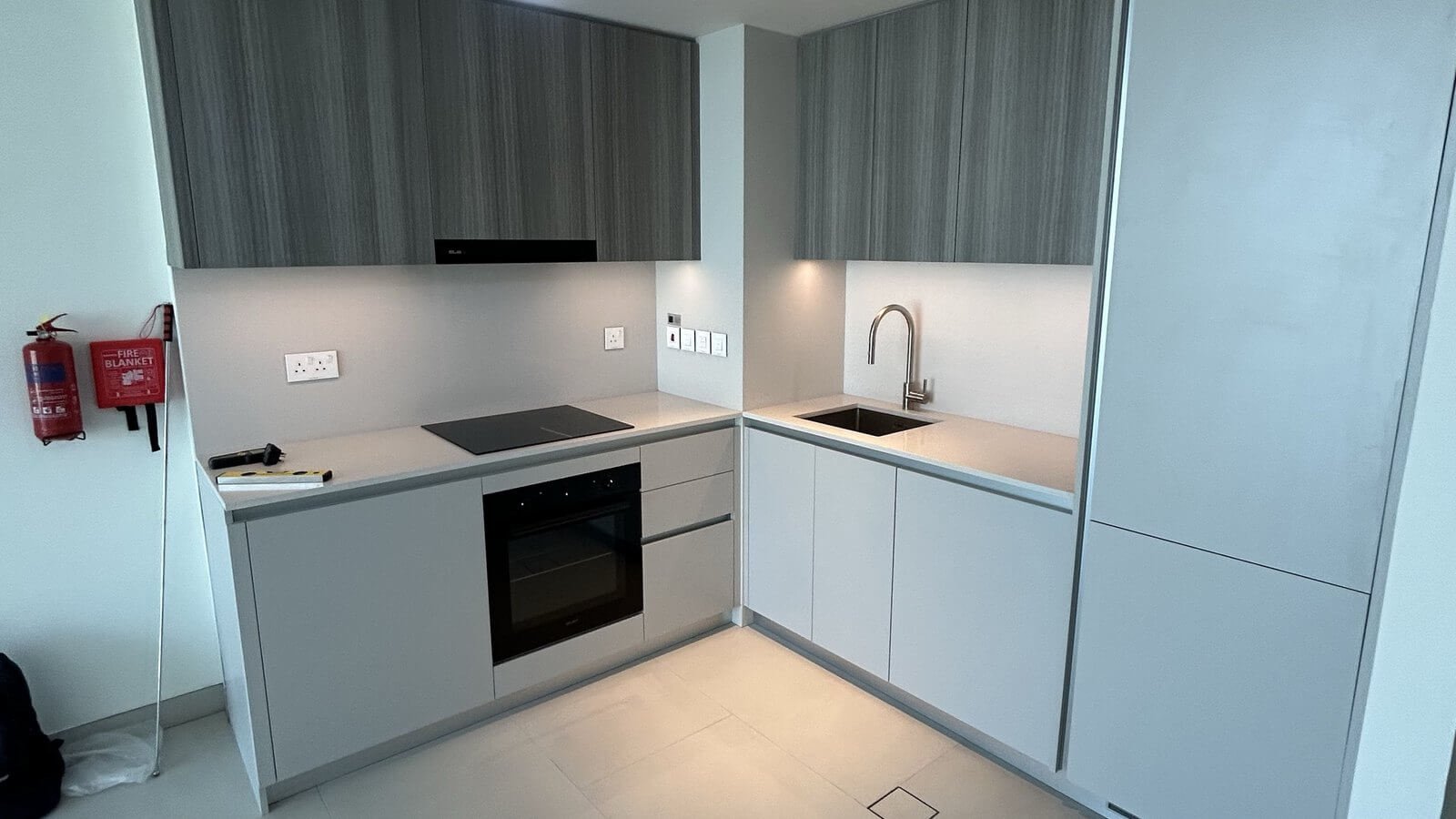
Kitchen inspection during a pre-handover snagging survey in Dubai
Why the bathroom and the balcony take the longest
If there is a pattern that repeats across apartment inspections in Dubai, it is this one: the bathroom absorbs a disproportionate share of the walk, and the balcony carries the highest consequence per observation.
Both are places where water is asked to go somewhere specific. Falls, terminations, grout lines, drain surrounds, sealant joints and the interface between two different materials — these are the details that read as cosmetic on handover day and present as a maintenance issue in year two.
Moisture above a ceiling is not a paint problem. It is a drainage problem wearing a paint problem’s clothes.
Recorded before handover, while the contractor is still on site and the Defects Liability Period has not started running, these are straightforward to close out. Recorded eighteen months later, they are a conversation.
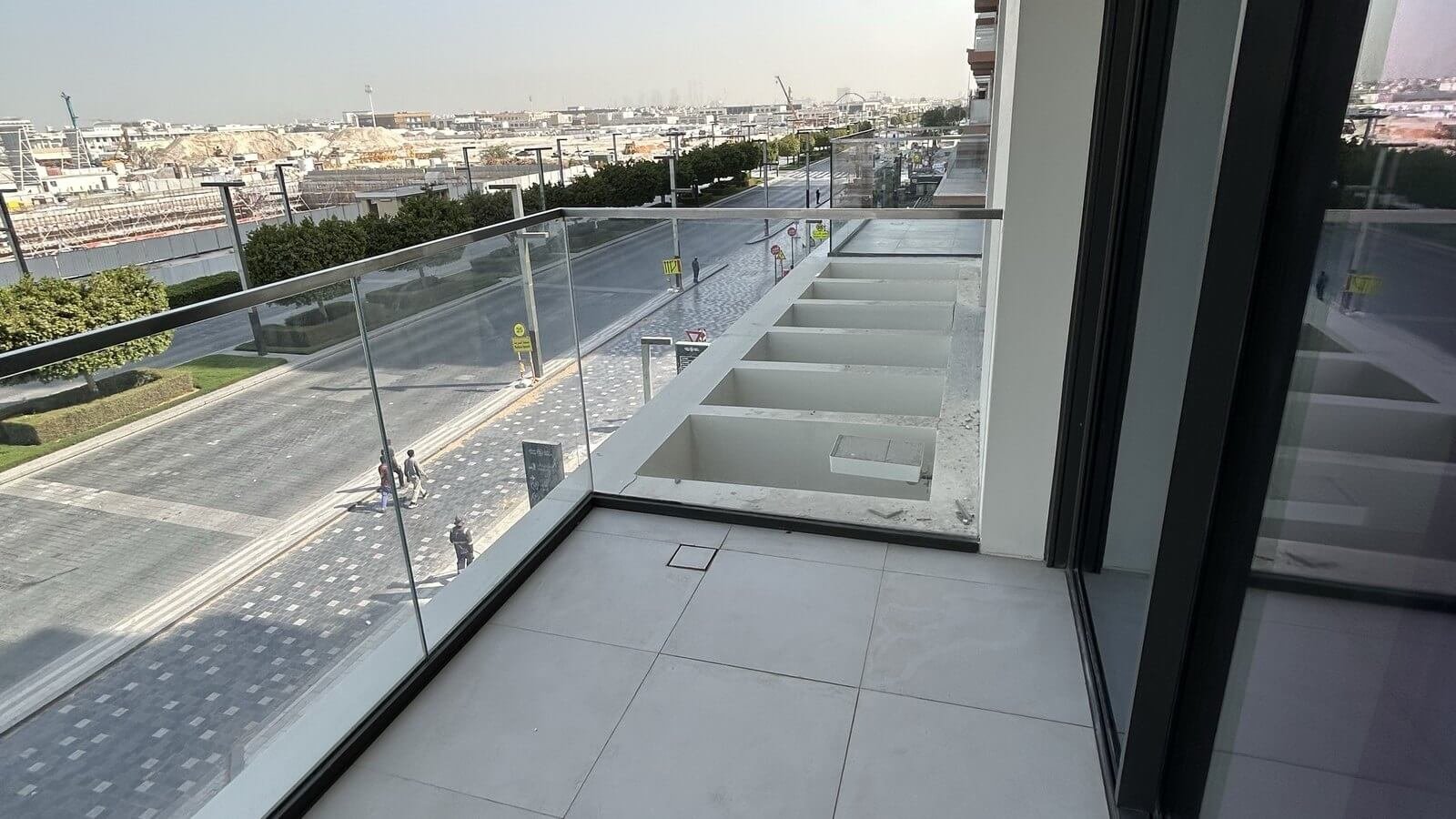
Balcony drainage and threshold inspection during a Dubai apartment snagging survey
What a snagging report has to do
The walk ends. The document begins.
What the client received here is a 34-page report built around the floor plan itself. Each observation carries a reference number, the section it sits in, the component it relates to, a plain description of what was seen, and a site photograph — a little over a hundred images across the set.
And every numbered observation appears as a pin on the general arrangement drawing on page one, so the developer’s team can read position at a glance rather than reconstructing it from text.
Why it matters: a snagging report is only as useful as the contractor’s ability to act on it. Ambiguity costs a site visit. Precision costs nothing.
How long does an apartment snagging inspection take in Dubai?
A one-bedroom apartment typically takes around 1.5 hours with one qualified engineer on site.
Larger apartments and villas take proportionally longer. Time on site is set by the property, not by a fixed appointment slot — and it is the wrong number to shop on. Scope is a function of who is walking, not how long they stay. An engineer covering every building system in ninety minutes produces a different document from a technician covering a checklist in three hours.
Five things to carry into your own handover
- Go before you sign. Observations raised at handover sit with the contractor while the Defects Liability Period is still ahead of you.
- Ask who is walking the property. An engineer reads systems. A checklist reads surfaces.
- Ask what the report looks like. A plan-referenced, photographed record is a working document. A spreadsheet of one-line entries is not.
- Make sure the services are tested, not just looked at. Hot water, air conditioning, drainage and the electrical enclosures behind them.
- Give the bathroom and the balcony the extra pass. Water finds its way into the expensive problems.
Frequently asked questions
1. What is a pre-handover inspection in Dubai?
An independent examination of a newly built property carried out before the buyer signs for the keys, so that anything requiring attention is recorded while responsibility for it still sits with the developer and contractor. It is commonly called a snagging inspection.
2. How long does a snagging inspection take for a one-bedroom apartment?
Around 1.5 hours with one qualified engineer on site. Larger units and villas take proportionally longer. Time on site is set by the property, not by a fixed appointment slot.
3.What gets checked during an apartment snagging inspection?
Every section of the unit from entrance to balcony — architectural finishes, joinery, glazing, tiling and ceilings, interior and sanitary fit-out, and MEP: domestic hot water delivery, chilled-water and condensate systems, fan coil units and their electrical enclosures.
4. Is snagging the same as a valuation or a building survey?
No. A valuation establishes price. A building survey assesses the structure of a property, usually an older one. A snagging inspection establishes condition and workmanship in a newly completed unit, against the standard the buyer is entitled to receive.
5. When should I book a snagging inspection?
Before handover is signed – ideally as soon as the developer issues the handover appointment. Booking early leaves room to complete the inspection and submit the report before the acceptance deadline.
6. What is the Defects Liability Period in Dubai?
The window after handover during which the developer remains responsible for putting defects right. In Dubai, a developer carries a ten-year liability for structural elements from the date of the completion certificate, and a one-year liability on mechanical and electrical installations from unit handover.
7. Can I still have the property inspected after I have taken handover?
Yes. A DLP re-inspection remains worthwhile at any point inside the liability period, and is most useful a month or two before the one-year mechanical and electrical cover expires.
8. Who should carry out the inspection?
Someone qualified to read building systems, not only surfaces. The Snag Master uses InterNACHI-certified civil engineers, works to RICS methodology, and is RERA certified and DED licensed.
9. What should a good snagging report contain?
A reference number for every observation, the section and component it relates to, a plain description of what was seen, a site photograph, and – the part most reports miss – a position marked on the floor plan so the contractor knows exactly where to go.
10. Does a brand-new apartment from a major developer still need inspecting?
Yes. A reputable developer and a well-built building do not remove the need for a record. The inspection is not a judgement on the developer; it is the buyer’s documented account of what was handed over, on the one day it can still be made.
Engineer-led property inspection across Dubai and the wider UAE, for buyers, investors, developers and building owners.
Don’t sign for the keys until someone qualified has walked it.
Your handover appointment is the one day the developer and contractor are both still on the hook. The Snag Master’s InterNACHI-certified civil engineers walk every section, from entrance to balcony. They test the services, not just the surfaces, and deliver a photo-referenced report with every observation pinned to your floor plan.
Great design is just the start. Quality assurance is the finish line.